Introduction
Upper Canada College (UCC) is one of Canada’s best-known independent schools and has played an important role in the educational history of Toronto and Ontario. Founded in 1829, the school has developed from a nineteenth-century educational institution into a modern independent day and boarding school for boys. Throughout its long history, UCC has experienced major changes in Canadian society, education, technology, culture, and the city of Toronto itself.
The history of Upper Canada College is closely connected with the development of Upper Canada, the region that later became the Canadian province of Ontario. When the institution was established in the early nineteenth century, Toronto was still a relatively small colonial settlement. Over the following two centuries, the city became one of North America’s major urban centres, while UCC grew into a prominent school with an international outlook.
The institution has traditionally emphasized academic achievement, character development, leadership, service, athletics, and participation in community life. Its graduates have gone on to careers in politics, business, law, medicine, education, journalism, the military, science, arts, and many other fields.
This article explores the history and development of Upper Canada College, from its founding in 1829 to its role as a modern educational institution.
1. The Foundation of Upper Canada College
Upper Canada College was founded in 1829 during an important period in the development of what was then known as Upper Canada.
The establishment of the school reflected the growing need for advanced education in the colony. Toronto, then known as York, was becoming increasingly important as a political and commercial centre. Leaders in the colony recognized that educational institutions would be necessary to prepare young people for professional, governmental, commercial, and civic responsibilities.
UCC was created as a public institution intended to provide a strong academic education. Its original educational model was influenced by British traditions, reflecting the political and cultural connections between Upper Canada and Britain.
The school’s founding represented an ambitious idea: young men should receive an education that combined academic learning with moral development, discipline, leadership, and preparation for public life.
From its earliest years, therefore, Upper Canada College was more than simply a place where students studied academic subjects. It was designed to develop individuals who could contribute to society.
2. Toronto and Upper Canada in the Nineteenth Century
To understand UCC’s early history, it is useful to understand the environment in which it was created.
During the early nineteenth century, Upper Canada was experiencing population growth and political development. Communities were expanding, transportation networks were improving, and institutions were being established across the colony.
Education was particularly important because the colony needed trained professionals, teachers, administrators, lawyers, clergy, and other educated citizens.
British educational traditions strongly influenced the curriculum and organization of many Canadian schools during this period. Classical education was particularly valued. Students often studied subjects such as Latin, Greek, mathematics, literature, history, geography, and moral philosophy.
Upper Canada College reflected many of these educational ideals.
Its early students were generally boys from families who valued formal education and expected their children to enter professional or leadership careers.
The school consequently developed a reputation for academic seriousness and discipline.
3. Early Educational Philosophy
From the beginning, UCC emphasized a broad understanding of education.
Academic knowledge was important, but education was also viewed as preparation for life.
Students were expected to develop discipline, responsibility, good manners, intellectual curiosity, and a sense of duty.
The nineteenth-century educational philosophy of the institution was strongly influenced by the idea that educated individuals should serve their communities.
This philosophy later developed into a broader emphasis on leadership and service.
Over time, the school continued to change its curriculum as society changed. Traditional subjects remained important, but modern sciences, languages, technology, arts, and other disciplines increasingly became part of education.
4. Development During the Nineteenth Century
The nineteenth century was a period of significant development for Upper Canada College.
The institution gradually established itself as an important school in Toronto. As Toronto’s population increased, the school became increasingly connected with the city’s social, economic, and professional communities.
The school also developed traditions that would later become an important part of its identity.
One of the strongest features of the institution’s history is continuity. Many generations of students have passed through the school while traditions, buildings, ceremonies, sporting activities, and alumni connections have continued to evolve.
At the same time, UCC did not remain completely unchanged.
Educational methods developed, subjects changed, and expectations surrounding schooling evolved. The school had to respond to the transformation of Canadian society.
5. The Move Toward a Modern School
As Toronto expanded during the late nineteenth and early twentieth centuries, Upper Canada College also evolved.
The growth of the city created new opportunities and challenges.
Modern science was becoming increasingly important. Industrialization was changing the economy. Universities were expanding. Professional careers were becoming more specialized.
Schools therefore needed to prepare students for a changing world.
UCC gradually expanded its academic offerings and adopted educational approaches appropriate for the modern era.
The traditional foundation remained, but education increasingly included science, modern languages, mathematics, literature, physical education, and other areas.
6. Upper Canada College and Canadian Society
One reason UCC is historically significant is its connection with Canadian society.
Over many generations, the school’s graduates entered influential professions.
Alumni have participated in public administration, politics, business, medicine, law, military service, education, journalism, science, and the arts.
This does not mean that every graduate followed a conventional leadership career. Rather, the school’s alumni network reflects the broad range of careers available to educated Canadians over the last two centuries.
The history of UCC therefore overlaps with the broader history of Toronto and Canada.
7. The School During the World Wars
The two World Wars had a profound effect on Canadian society, including schools.
Like many educational institutions, Upper Canada College was affected by military service and wartime mobilization.
Students, teachers, alumni, and families were connected to Canada’s war effort in different ways.
Young men from the school served in Canada’s armed forces during periods of national conflict. Some lost their lives.
Memorials and commemorative traditions became important parts of school life.
The experience of war also affected education itself. Questions of citizenship, responsibility, sacrifice, leadership, and service became particularly significant.
For generations of UCC students, remembrance became connected with the school’s understanding of community and responsibility.
8. The Interwar Period
Between the First and Second World Wars, Canadian society underwent major transformation.
Toronto became a much larger and more modern city. Technology developed rapidly, transportation improved, and the economy became increasingly industrial and commercial.
Upper Canada College continued to provide a traditional independent-school education while gradually responding to modern developments.
Athletics became an increasingly visible part of school culture.
Sports were viewed not simply as physical activities but as opportunities to develop teamwork, discipline, resilience, leadership, and sportsmanship.
These principles became important elements of the school’s educational philosophy.
9. The Second World War
The Second World War again brought major changes to UCC and Canadian society.
The conflict affected families throughout Toronto.
Students and alumni participated in the national war effort, and the school community experienced loss.
The wartime period reinforced the importance of remembrance and public service.
After the war, Canadian society entered a period of major economic and demographic expansion. Education became increasingly important as Canada developed into a modern industrial and eventually post-industrial society.
10. Postwar Expansion
The decades following the Second World War were an important period in the development of Upper Canada College.
Toronto was rapidly expanding, and Canada’s population was becoming increasingly diverse.
Educational expectations changed.
Universities and professional careers became accessible to larger numbers of Canadians. Scientific and technological development accelerated.
UCC responded by developing modern academic programs while maintaining its traditional emphasis on character and community.
The postwar period also brought changes in teaching methods, student activities, athletics, arts programs, and extracurricular opportunities.
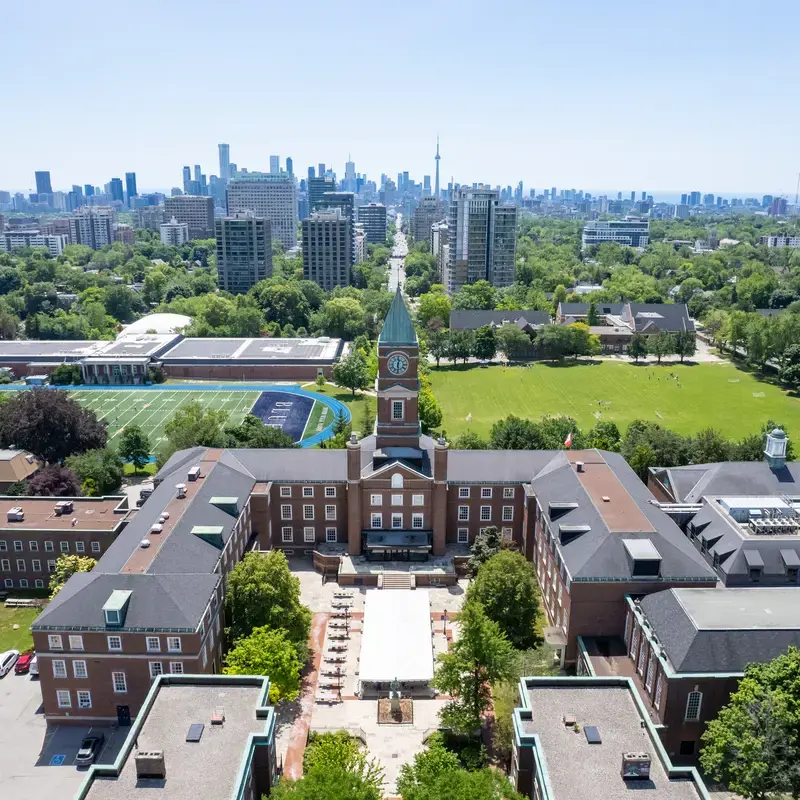
11. The School’s Campus
The campus has always been an important part of the UCC experience.
A school is not simply a collection of classrooms. Buildings, fields, libraries, laboratories, athletic facilities, performance spaces, and gathering areas all contribute to student life.
Over its history, UCC has developed and modernized its facilities to support changing educational requirements.
The campus environment is designed to support both academic and extracurricular activities.
Classrooms provide space for teaching and discussion, while specialized facilities support science, technology, arts, music, and other programs.
Athletic facilities provide opportunities for students to participate in competitive and recreational sports.
12. Academic Education at UCC
Academic excellence has traditionally been central to Upper Canada College.
The school provides a broad education intended to develop students intellectually as well as personally.
Subjects commonly associated with a modern independent-school curriculum include:
- English and literature
- Mathematics
- Science
- History
- Geography
- Languages
- Computer science
- Visual arts
- Music
- Drama
- Physical education
- Social sciences
The objective is not simply to prepare students for examinations.
A strong education should also teach students how to think.
Critical thinking, communication, research, problem-solving, creativity, collaboration, and independent learning are important components of modern education.
13. The International Baccalaureate
One of the important developments in modern UCC education has been its relationship with the International Baccalaureate framework.
The International Baccalaureate emphasizes broad academic learning, critical thinking, international awareness, independent research, and intellectual curiosity.
An internationally oriented curriculum can help students understand that their education exists within a global environment.
Modern graduates may attend universities in Canada, the United States, Britain, Europe, Asia, Australia, and other parts of the world.
An international perspective can therefore be valuable.
14. Character Education
Upper Canada College has historically emphasized character as an important part of education.
Academic success alone does not determine whether a person becomes a responsible member of society.
Character education can involve values such as:
- Integrity
- Respect
- Responsibility
- Courage
- Empathy
- Honesty
- Perseverance
- Leadership
- Service
Students are encouraged to understand that their decisions affect other people.
This philosophy is particularly important in a school environment because students are learning how to work with people who have different personalities, perspectives, interests, and abilities.
15. Leadership Development
Leadership is another important component of the UCC educational experience.
Leadership does not necessarily mean holding a formal position.
A student can demonstrate leadership by helping classmates, organizing an activity, contributing to a team, supporting a community initiative, or taking responsibility for a difficult project.
The school environment provides students with many opportunities to practice leadership.
Student councils, clubs, sports teams, arts groups, community-service projects, and other activities can all develop leadership skills.
These experiences can help students become more confident and responsible.
16. Athletics at Upper Canada College
Athletics have traditionally played a major role in UCC life.
Sports provide physical benefits, but their educational value goes much further.
Participation in athletics can teach students:
- Teamwork
- Discipline
- Resilience
- Strategic thinking
- Communication
- Goal setting
- Sportsmanship
- Responsibility
Competitive sports also teach students how to respond to success and failure.
A victory can provide confidence, while a defeat can provide an opportunity to learn, improve, and try again.
This is one reason athletics are often considered an important part of independent-school education.
17. Arts and Creative Education
A well-rounded education also requires opportunities for creativity.
UCC’s educational environment includes opportunities in areas such as music, visual arts, theatre, performance, and creative expression.
Arts education can develop imagination and communication skills.
It can also encourage students to understand different perspectives and cultures.
Performing in front of an audience can improve confidence. Creating artwork can develop observation and creativity. Studying music can strengthen discipline and listening skills.
The arts therefore complement traditional academic education.
18. Clubs and Extracurricular Activities
School life extends beyond classrooms.
Students can participate in extracurricular activities that reflect their interests.
Clubs and activities can cover academic subjects, sports, arts, culture, technology, community service, and many other areas.
Extracurricular activities provide students with opportunities to meet people outside their normal classes.
They can also discover interests that may influence their future studies or careers.
19. Community Service
Service has long been connected with the philosophy of many independent schools, including UCC.
Community service encourages students to recognize responsibilities beyond themselves.
Service activities can involve supporting local communities, participating in charitable initiatives, environmental projects, fundraising, mentoring, and other forms of volunteer work.
The educational value of service is that students can move from discussing social responsibility to practicing it.
20. Boarding Education
Historically, boarding has been an important part of UCC’s identity.
Boarding education provides students with a distinctive school experience because students live within a structured educational community.
Boarders learn to manage daily responsibilities, develop independence, and interact closely with other students.
Boarding communities can also create strong friendships.
Living together encourages students to develop communication skills, cooperation, and consideration for others.
21. Diversity and Global Outlook
Modern education increasingly recognizes the importance of diversity.
Students come from different backgrounds, cultures, interests, and family experiences.
A school that prepares students for modern society needs to help them understand these differences.
UCC’s international outlook reflects the increasingly global nature of Toronto and Canada.
Students can benefit from learning about cultures and perspectives beyond their immediate surroundings.
Global education also encourages students to think about international issues and their responsibilities as members of a connected world.
22. The Importance of Toronto
UCC’s identity cannot be separated from Toronto.
Toronto has grown from a relatively small nineteenth-century settlement into Canada’s largest metropolitan centre.
The city is home to major financial institutions, universities, hospitals, technology companies, cultural organizations, museums, theatres, sports organizations, and international communities.
For students, being educated in such a city can provide opportunities to engage with a diverse social and cultural environment.
The school’s history therefore reflects the transformation of Toronto itself.
23. UCC and University Preparation
For many students, secondary education is an important stage before university.
Upper Canada College has a long tradition of preparing students for higher education.
University preparation involves more than good grades.
Students need to develop research abilities, writing skills, critical thinking, time management, independence, and confidence.
Modern university admissions can also consider extracurricular involvement, leadership, community participation, and personal achievements.
A broad educational program can therefore prepare students for multiple dimensions of university life.
24. Alumni and the Old Boy Network
The alumni community is an important part of UCC’s identity.
Graduates of the school are often referred to as Old Boys, reflecting a traditional terminology used by many historic boys’ schools.
Alumni networks can provide social and professional connections.
Former students may return to the school as mentors, speakers, volunteers, donors, coaches, or supporters.
These relationships create continuity between generations.
A student can therefore become part of a community that extends beyond the years spent in classrooms.
25. Notable Alumni
Over its long history, UCC has produced graduates who have become prominent in Canadian and international life.
Alumni have included individuals involved in politics, government, business, medicine, law, journalism, education, science, military service, entertainment, and other fields.
The range of careers represented by alumni demonstrates the broad nature of the education provided by the institution.
However, the value of an alumni community should not be measured only by famous names.
Thousands of graduates have contributed to their communities through ordinary professional and civic work.
26. School Traditions
Traditions are an important part of historic educational institutions.
UCC has developed traditions relating to ceremonies, sports, school houses, uniforms, music, alumni activities, commemorations, and student leadership.
Traditions can provide students with a sense of belonging.
They connect current students with previous generations.
At the same time, traditions must evolve.
A modern school cannot simply reproduce the culture of the nineteenth century. It must preserve valuable elements of its heritage while responding to contemporary expectations.
27. The Evolution of the UCC Identity
The identity of Upper Canada College has changed over nearly two centuries.
In its early period, the school reflected the colonial culture of Upper Canada.
During the twentieth century, it became increasingly Canadian in identity.
In the twenty-first century, it operates within a multicultural and global city.
This evolution demonstrates how educational institutions can preserve historical continuity while adapting to social change.
The school today is not identical to the school founded in 1829.
Nevertheless, there are recognizable connections between the institution’s original emphasis on education, character, responsibility, and leadership and its modern mission.
28. Technology and Modern Education
Technology has transformed education.
Students today have access to digital information on a scale that earlier generations could not imagine.
Computers, online research, digital communication, educational software, artificial intelligence, and multimedia resources have changed how students learn.
Modern schools therefore face a new challenge.
The objective is not simply to provide students with technology. Students must learn how to use technology responsibly and intelligently.
They need to evaluate sources, recognize misinformation, protect privacy, communicate appropriately, and use digital tools for meaningful learning.
UCC, like other modern schools, operates within this changing educational environment.
29. Science and Innovation
Science education is increasingly important in the modern world.
Students need opportunities to understand biology, chemistry, physics, environmental science, technology, and related fields.
Scientific education teaches students how to ask questions, form hypotheses, analyze evidence, and reach conclusions.
These skills are useful even for students who do not become scientists.
They can improve decision-making in everyday life.
30. Environmental Awareness
Environmental issues have become a major part of modern education.
Climate change, biodiversity, pollution, resource management, and sustainability affect communities around the world.
Schools can help students understand these challenges through science, geography, social studies, service activities, and campus initiatives.
Environmental education also encourages students to think about long-term consequences.
31. Mental Well-Being and Student Support
Modern education increasingly recognizes that student success depends on well-being as well as academic performance.
Students may experience academic pressure, social challenges, changing expectations, and uncertainty about the future.
Schools therefore need systems that support students as individuals.
Advisory programs, counseling, pastoral care, mentoring, healthy athletics, friendships, and supportive teachers can all contribute to student well-being.
The modern understanding of education is increasingly holistic.
32. Teachers and the Educational Community
No school can succeed without effective teachers.
Teachers do much more than deliver lessons.
They mentor students, provide feedback, encourage curiosity, manage classrooms, support extracurricular activities, and often serve as role models.
The relationship between teacher and student is one of the most important elements of school life.
A strong teacher can influence a student’s interests and future direction for many years.
33. Parents and the School Community
Parents also play an important role in education.
Successful schooling generally requires communication between families and the institution.
Parents support learning by encouraging good habits, attending school activities, communicating with teachers, and helping students develop independence.
At an independent school, the relationship between school and family can be especially significant.
34. The Meaning of an Independent School
Upper Canada College belongs to Canada’s independent-school tradition.
Independent schools typically have greater flexibility in curriculum development, extracurricular programming, campus organization, and institutional priorities than many public schools.
They may also have strong alumni communities and extensive extracurricular programs.
At the same time, independent schools face responsibilities related to accessibility, inclusion, affordability, student well-being, and educational quality.
The modern independent-school model continues to evolve.
35. Challenges Facing Modern Schools
Even prestigious schools face significant challenges.
Education is changing rapidly.
Schools must consider:
- Artificial intelligence
- Digital learning
- Student mental health
- Diversity and inclusion
- Environmental sustainability
- Changing university admissions
- Economic inequality
- Cybersecurity
- Social media
- Global uncertainty
A school with a long history must balance tradition with innovation.
For UCC, this is particularly important because of its nearly two-century institutional heritage.
36. Tradition Versus Innovation
One of the most interesting aspects of UCC’s history is the relationship between tradition and change.
Tradition provides identity.
Innovation provides relevance.
If a school focuses only on tradition, it can become disconnected from modern society.
If it focuses only on innovation, it can lose the historical identity that gives its community meaning.
The challenge is to combine both.
UCC’s history demonstrates an ongoing process of adaptation.
37. Why UCC Remains Historically Important
Upper Canada College is historically important for several reasons.
First, it is one of Canada’s longstanding educational institutions.
Second, its history reflects the development of Toronto.
Third, its alumni have participated in many areas of Canadian public and professional life.
Fourth, its educational philosophy illustrates the evolution of independent education in Canada.
Finally, its survival and development over nearly two centuries demonstrate the ability of educational institutions to adapt to changing societies.
38. UCC in the Twenty-First Century
The twenty-first century has brought a new educational environment.
Students are preparing for careers that may not even exist in their current form.
Artificial intelligence, biotechnology, renewable energy, digital communications, automation, and global commerce are transforming society.
A modern school must therefore develop adaptable learners.
Students need to know how to learn, not simply what to memorize.
They need curiosity, resilience, communication skills, creativity, and ethical judgment.
These qualities are particularly important in an uncertain future.
39. The Importance of Global Citizenship
Global citizenship has become increasingly important.
A student in Toronto can communicate instantly with people across the world.
Universities and workplaces are international.
Businesses operate across borders.
Global challenges such as climate change, pandemics, technological development, migration, and economic instability cannot be understood entirely through a local perspective.
Education must therefore encourage students to understand both local and global communities.
40. Preparing Students for Leadership
Leadership education is particularly valuable because future leaders need more than technical knowledge.
They need judgment.
They need empathy.
They need the ability to listen.
They need to understand complex problems.
They need to make decisions while recognizing consequences.
A school can begin developing these qualities long before students enter professional life.
41. The Role of School Spirit
School spirit is another important feature of UCC life.
School spirit can emerge through sports competitions, performances, assemblies, traditions, student organizations, and community events.
These activities create shared experiences.
Shared experiences help students feel that they belong to something larger than themselves.
For a historic institution, school spirit also connects current students with previous generations.
42. The Value of Friendship
School years are not only about academics.
Friendships formed during school can become some of the most influential relationships in a person’s life.
Students learn how to cooperate, resolve disagreements, support one another, and build trust.
Boarding and extracurricular activities can strengthen these connections because students spend significant amounts of time together.
43. UCC’s Historical Legacy
The legacy of Upper Canada College is not represented by one building, one headmaster, one generation, or one group of alumni.
It is the cumulative result of nearly two centuries of students, teachers, families, traditions, successes, challenges, and changes.
Every generation contributes something.
Older generations provide historical memory.
Current students bring new ideas.
Teachers provide continuity.
Alumni maintain connections.
Together, these elements create institutional identity.
44. Education Beyond the Classroom
One of the central lessons of UCC’s history is that education extends beyond textbooks.
Students learn through:
- Sports
- Music
- Theatre
- Clubs
- Leadership
- Community service
- Friendships
- Travel
- Competition
- Failure
- Responsibility
These experiences can shape personality as strongly as classroom instruction.
A successful school therefore creates opportunities for students to learn in many different environments.
45. Why the History of UCC Matters
Studying the history of Upper Canada College is useful because it provides a window into Canadian educational history.
The institution was founded when Canada looked very different from today.
Toronto was smaller.
Technology was limited.
Communication was slow.
Society was organized differently.
Yet many educational questions remain familiar.
How should young people be educated?
What qualities should schools develop?
How should education prepare students for citizenship?
How should schools balance tradition and change?
These questions have remained relevant across generations.
46. A School Connected to Canadian History
Upper Canada College has existed through some of Canada’s most important historical periods.
It has witnessed Confederation and the creation of modern Canada.
It has experienced the First World War and Second World War.
It has seen the transformation of Toronto into a major global city.
It has experienced technological revolutions.
It has adapted to social and cultural change.
Few institutions can claim such a long continuous relationship with the development of a major Canadian city.
47. The Future of Upper Canada College
The future of UCC will depend on its ability to remain relevant while preserving its core identity.
Future students will face challenges that earlier generations could not have predicted.
Artificial intelligence may transform employment.
Climate change may reshape economies and communities.
Global communication will continue to accelerate.
Education will increasingly involve digital and interdisciplinary learning.
The school will therefore need to continue adapting.
At the same time, qualities such as integrity, curiosity, courage, responsibility, friendship, and service are unlikely to become outdated.
48. Conclusion
Upper Canada College has a remarkable history that stretches back to 1829.
From its beginnings in nineteenth-century Upper Canada to its position in modern Toronto, the institution has experienced almost two centuries of social, political, economic, cultural, and technological change.
Its history includes academic development, athletic traditions, community service, leadership education, wartime experiences, alumni achievements, campus development, and adaptation to modern educational demands.
Perhaps the most important feature of UCC’s history is its ability to combine continuity with change.
The school has preserved traditions while responding to new educational needs.
Its students have gone into many different professions and communities, contributing to Canadian society in numerous ways.
Today, Upper Canada College remains part of Toronto’s educational landscape and continues the long tradition of preparing young people for university, professional life, citizenship, and leadership.
The story of Upper Canada College is ultimately a story about education itself: how institutions preserve knowledge and traditions while preparing each new generation for a world that is constantly changing.
For almost two centuries, the school has provided an environment in which students can study, compete, create, serve, build friendships, develop leadership skills, and discover their individual potential.
Its history is therefore not only about the past. It is also about the continuing relationship between education, character, community, and the future.
Frequently Asked Questions About Upper Canada College
1. When was Upper Canada College founded?
Upper Canada College was founded in 1829 in Toronto, during the period when the region was known as Upper Canada.
2. Where is Upper Canada College located?
Upper Canada College is located in Toronto, Ontario, Canada.
3. What type of school is UCC?
Upper Canada College is an independent school traditionally serving boys, with educational programs spanning the school years leading toward university preparation.
4. What is Upper Canada College known for?
UCC is particularly known for its long history, academic education, athletics, leadership development, traditions, alumni community, and connection to Toronto.
5. Does UCC have a long history?
Yes. The institution was founded in 1829, giving it a history of almost two centuries.
6. What subjects do students study at UCC?
Students can study a broad range of subjects, including mathematics, sciences, English, languages, history, social sciences, arts, technology, and physical education.
7. Does Upper Canada College emphasize athletics?
Yes. Athletics have traditionally been an important component of student life and are often connected with teamwork, discipline, leadership, and sportsmanship.
8. Does UCC offer extracurricular activities?
Yes. Students can participate in a wide variety of activities involving sports, arts, clubs, leadership, community service, and other interests.
9. Why is UCC historically significant?
Its long history, connection with Toronto, educational traditions, alumni community, and role in Canadian independent education make it historically significant.
10. What is the legacy of Upper Canada College?
Its legacy includes generations of graduates, educational traditions, academic programs, athletic achievements, community involvement, and a continuing emphasis on developing responsible and capable young people.
Final Thoughts
Upper Canada College represents an important part of Canada’s educational history. Its journey from a nineteenth-century colonial institution to a modern school in one of Canada’s largest cities illustrates how education evolves alongside society.
Its buildings, traditions, classrooms, sports fields, teachers, students, alumni, and community all contribute to a story that has continued for generations.
The most meaningful legacy of any school is ultimately the people it helps educate. In that sense, the history of Upper Canada College is not finished. Every new generation of students adds another chapter to a story that began in 1829.