Introduction to Eton College
Eton College is one of the most famous and historically significant schools in England. Located in Eton, Berkshire, close to Windsor, the school has educated generations of students since its foundation in the 15th century. Known for its long history, distinctive traditions, academic opportunities and boarding system, Eton has become an internationally recognized name in British education.
Founded by King Henry VI in 1440, Eton was originally established to provide education for a group of scholars who would later progress to King’s College, Cambridge. Over almost six centuries, the institution developed from a medieval grammar school into a modern full-boarding school for boys aged approximately 13 to 18. (Eton College Collections)
Today, Eton combines historic traditions with contemporary education. The school describes its educational approach as one that develops students academically while also encouraging creativity, independence, leadership, service and participation beyond the classroom. Its co-curricular programme includes academic societies, sports, music, arts and numerous other activities. (Eton College)
Eton College is also highly selective. Admission is competitive, and prospective students are assessed for academic potential as well as their suitability for boarding life. The school typically welcomes boys from a wide range of schools and backgrounds. (Eton College)
This comprehensive guide explores Eton College history, academic programmes, admissions, fees, scholarships, boarding life, traditions, facilities, extracurricular activities, famous alumni and the reasons the school remains influential in British education.
1. The History of Eton College
The history of Eton College stretches back to 1440, when King Henry VI founded the institution. The original purpose was very different from the modern school that visitors see today.
Henry VI intended Eton to educate 25 poor and indigent scholars. The foundation was connected to his wider educational vision and to his establishment of King’s College, Cambridge. The early curriculum focused heavily on classical education, particularly Latin. (Eton College Collections)
In its earliest period, Eton was a small institution with a strongly religious and classical character. Latin dominated education, and students were expected to learn through memorization, writing and study of classical texts.
Greek became part of the curriculum centuries later. For a significant portion of its early history, classical languages remained central to the school’s educational identity.
Eton’s Medieval Origins
The 15th century was a period when education in England was undergoing considerable change. Henry VI wanted to strengthen educational opportunities and established Eton as part of a broader educational foundation.
The school’s original foundation charter dates from 11 October 1440, and Eton’s archives preserve extensive records documenting its development. The College Archives contain material relating to curriculum, sports, societies, boarding houses and school administration. (Eton College Collections)
Over time, the school became increasingly prominent within English society.
2. How Eton College Changed Over the Centuries
Eton’s history is not simply a story of preserving tradition. The institution has repeatedly changed its curriculum and educational methods.
For centuries, classical subjects dominated education. However, the demands of modern universities, government, science and professional careers eventually encouraged the school to expand its curriculum.
One important development came in the 19th century, when mathematics was formally introduced. Eton’s own historical material explains that mathematics was added in 1851 because of changing requirements from universities and the Army. (Eton College Collections)
Further reforms followed the Public Schools Act of 1868, which affected several major English public schools. Eton expanded its academic offerings and introduced subjects including modern languages, history, chemistry, geography and other disciplines. (Eton College Collections)
These developments gradually transformed Eton from a predominantly classical school into a broader educational institution.
By the modern period, Eton had developed a curriculum covering sciences, humanities, languages, mathematics, arts and numerous other areas.
3. Eton College Today
Modern Eton College remains a boys’ boarding school with a strong emphasis on both academic and personal development.
The school currently has around 1,350 boys, according to its admissions information. Eton describes itself as a full-boarding environment where students live within the school community and participate in a wide range of activities. (Eton College)
The school aims to provide an environment in which students can develop academically, socially and personally.
Rather than focusing exclusively on classroom examinations, Eton places considerable emphasis on activities outside traditional lessons. Its current programme includes more than 80 student societies, with lectures, workshops and seminars involving experts from different fields. (Eton College)
This combination of academic learning and extracurricular opportunity is an important part of the Eton experience.
4. Academic Education at Eton College
Academic education is one of the central features of Eton College.
The school aims to encourage students to become independent thinkers who can investigate ideas rather than simply memorize information.
Eton’s educational philosophy emphasizes:
- Independent thinking
- Intellectual curiosity
- Academic excellence
- Creativity
- Research
- Communication
- Critical analysis
- Problem-solving
- Personal responsibility
The school also supports research into teaching and learning through its Tony Little Centre for Innovation and Research in Learning. Eton describes the centre as part of its effort to investigate effective approaches to education. (Eton College)
A Broad Curriculum
Eton’s historical development demonstrates how its curriculum expanded from a narrow classical model into a much broader programme.
Modern students can study a wide range of academic disciplines, depending on their age, interests and educational pathway.
The broad curriculum helps students prepare for university and future careers while allowing them to explore subjects that may become lifelong interests.
5. Learning Beyond the Classroom
One of Eton’s distinctive characteristics is its emphasis on learning outside ordinary lessons.
The school states that students can learn as much, or even more, outside the classroom through its extensive co-curricular programme. (Eton College)
Students can participate in activities involving:
- Sport
- Music
- Theatre
- Art
- Debate
- Academic societies
- Technology
- Science
- Community service
- Leadership
- Outdoor activities
- Cultural programmes
This approach can help students discover abilities that may not become visible through examinations alone.
For example, a student who struggles to identify a particular strength through classroom study might discover a passion for music, drama, sport, public speaking or scientific research through co-curricular activities.
6. Eton College Boarding Life
Boarding is a major part of the Eton experience.
Unlike a day school, where students return home each afternoon, Eton’s students live within the school community. Boarding creates an environment where academic, social and extracurricular activities become part of everyday life.
Students develop relationships with teachers, house staff and other students while participating in school traditions and activities.
The boarding environment can encourage:
- Independence
- Time management
- Responsibility
- Friendship
- Teamwork
- Leadership
- Self-confidence
- Adaptability
The residential system also creates a strong sense of community.
7. Eton’s Boarding Houses
Eton students live within boarding houses. These houses play an important role in daily school life.
A boarding house is more than simply accommodation. It can become the social centre of a student’s school experience.
Students eat, study, relax and participate in activities within their house community.
House systems also encourage healthy competition through sports, music, academic events and other activities.
For many students, friendships developed within boarding houses can continue long after graduation.
8. Student Life at Eton College
Student life at Eton is highly structured but also offers extensive opportunities for personal choice.
A typical student may spend part of the day attending academic lessons and another part participating in sports, music, societies or other activities.
The school’s large co-curricular programme allows students to develop interests beyond their academic subjects.
Eton reports that students have established more than 80 societies. These societies provide opportunities to discuss ideas, organize events and learn from guest speakers. (Eton College)
Such opportunities can help students develop communication and organizational skills that are valuable beyond school.
9. Sports at Eton College
Sport has traditionally been an important part of life at Eton.
Students can participate in a variety of competitive and recreational sports. Athletics, team games and other physical activities contribute to the school’s broader educational philosophy.
Sports can teach students:
- Teamwork
- Discipline
- Resilience
- Leadership
- Strategic thinking
- Fitness
- Cooperation
Eton is also famous for distinctive sporting traditions that form part of its historic identity.
10. The Eton Wall Game
One of the school’s most recognizable traditions is the Eton Wall Game.
The game is played beside a long brick wall on the Eton campus. It is very different from conventional modern sports and has developed into an important part of the school’s culture.
The Wall Game demonstrates how traditional activities continue to exist alongside modern education.
For students, participation in historic activities can create a connection with generations of Etonians who attended the school before them.
11. Music and the Arts
Music and the arts are another important part of Eton’s educational environment.
The school offers opportunities for students interested in instrumental music, singing, performance and other creative disciplines.
Eton’s published information has highlighted dozens of instrumental ensembles and a substantial programme of musical activities. (Eton College)
Students can develop skills through:
- Choirs
- Bands
- Instrumental ensembles
- Individual lessons
- Performances
- Musical societies
- Theatre
- Visual arts
Creative activities can complement academic education by encouraging imagination and expression.
12. Societies and Student Interests
Eton students can explore interests through academic and non-academic societies.
The school reports more than 80 societies, giving students opportunities to explore specialized subjects and passions. (Eton College)
Societies can cover areas such as:
- Science
- Politics
- History
- Literature
- Philosophy
- Technology
- Economics
- Music
- Art
- Languages
- Current affairs
Guest speakers also contribute to the intellectual environment. According to Eton, society programmes have included speakers such as former political leaders, Nobel laureates, business leaders, academics and scientists. (Eton College)
13. Eton College Admissions
Admission to Eton is highly selective.
The school assesses prospective students not only for current academic performance but also for academic potential and their ability to thrive in a boarding environment. (Eton College)
For standard entry, boys are generally registered for entry at age 13.
Eton states that registration can take place up to the end of UK School Year 5, with later entry routes available in certain circumstances, including scholarship and Sixth Form entry. (Eton College)
Because the admissions process involves several stages, families considering Eton should begin researching requirements well before the intended entry year.
14. Academic Assessment
Academic ability is an important component of Eton’s admissions process.
The school considers a student’s current achievement and potential.
Depending on the entry route, candidates may encounter assessments connected with:
- Academic ability
- Entrance examinations
- Common Entrance
- King’s Scholarship
- Sixth Form admissions
The precise requirements depend on the student’s route into the school.
Eton’s admissions department provides guidance to families throughout the process. (Eton College)
15. King’s Scholars at Eton
One of Eton’s most famous traditions is the King’s Scholarship.
Students admitted through this scholarship route become known as King’s Scholars. Other students are traditionally referred to as Oppidans.
The King’s Scholarship is academically demanding and is associated with Eton’s historic foundation.
Scholarship applicants must meet the relevant academic requirements and complete the appropriate assessment process.
16. Sixth Form Entry
Eton also has a route for students entering the Sixth Form.
Sixth Form students generally join at age 16 and undertake advanced academic study before university.
This pathway can be particularly attractive to students who want the Eton educational experience for their final years of school.
Admissions for Sixth Form entry are separate from the main 13+ admissions pathway and have their own requirements.
17. Eton College Fees
Eton is a fee-paying independent boarding school, and attending it represents a significant financial commitment.
For the 2026/27 academic year, Eton’s published fee is £21,891 per half, including VAT. There are three halves in an academic year, meaning the basic annual figure based on that published termly amount is approximately £65,673, before additional extras. (Eton College)
The school explains that fees include tuition, boarding, lodging and most games activities and educational materials. Additional costs can include music lessons, trips, boat club membership and other activities. (Eton College)
Families should therefore consider both the basic school fee and possible additional expenses when planning financially.
18. Additional Costs at Eton
In addition to tuition and boarding charges, students may incur extra costs.
Examples can include:
- Music lessons
- Educational trips
- Optional insurance
- Boat club membership
- Certain activities
- Other school-related expenses
Eton currently states that extras usually range between £500 and £1,500 per half, although the exact amount depends on the activities a student chooses. (Eton College)
International students who require Eton to sponsor a UK Child Student Visa or Student Visa may also have an additional annual charge.
19. Scholarships and Financial Assistance
Although Eton is expensive, the school provides financial assistance to eligible families.
Eton states that its bursaries are means-tested and are intended to help talented boys whose families might otherwise be unable to consider the school because of financial circumstances. (Eton College)
The school reported that 18% of boys received financial support during the 2023/24 academic year, with the average award covering a substantial portion of fees. (Eton College)
This financial assistance is important because it allows students from different economic backgrounds to access the school.
20. Eton’s Bursary Programme
Eton’s bursary system is based on financial need.
Parents applying for assistance may be required to provide detailed financial information as part of a means-testing process.
The school emphasizes that bursary applications are treated confidentially.
Eton also explains that its bursary funds cannot satisfy every application, meaning that financial assistance is competitive. (Eton College)
Families considering Eton should therefore investigate bursary requirements as early as possible.
21. Diversity and Access
For much of its history, Eton was associated with Britain’s traditional elite. However, modern Eton has sought to widen access through financial aid and outreach.
The school states that it welcomes students from a broad range of schools and backgrounds.
Its admissions information indicates that students come from approximately 120 different state and independent schools each year. (Eton College)
Financial support is one of the principal ways the school attempts to broaden access.
22. Eton College Campus
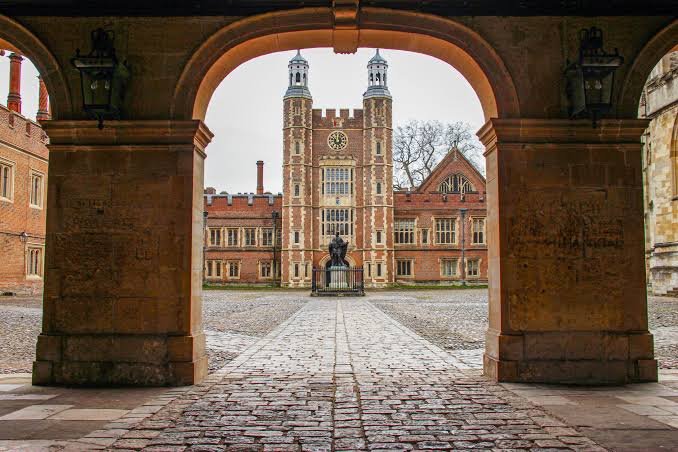
Eton’s campus combines centuries-old architecture with modern educational facilities.
The historic environment contributes significantly to the school’s identity.
Students study and live in an environment shaped by buildings, traditions and institutions developed across generations.
At the same time, Eton continues to invest in educational resources and facilities to support modern teaching, sport, science, arts and extracurricular activities.
23. Eton and Windsor
Eton College is located in Berkshire, close to Windsor and Windsor Castle.
Its location gives the school a distinctive geographical identity.
The surrounding area has a long connection with the British monarchy and national history, while the school’s own history is closely associated with royal patronage.
The proximity to Windsor also makes Eton relatively accessible from London and other parts of southern England.
24. Famous Eton Traditions
Eton is known worldwide for its traditions.
Some traditions have developed over hundreds of years, while others have changed with time.
Examples include:
- Distinctive school terminology
- Boarding-house traditions
- Formal school dress
- The Eton Wall Game
- Eton societies
- Musical traditions
- Academic customs
- Sporting competitions
- House events
These traditions contribute to the strong institutional identity that many people associate with Eton.
25. Eton’s Famous Alumni
Eton has educated numerous notable figures throughout British history.
Its alumni include politicians, writers, scientists, military figures, artists and members of the British royal family.
Two particularly well-known modern alumni are Prince William and Prince Harry.
The association with the British royal family has contributed significantly to Eton’s international profile.
The school has also educated numerous British prime ministers and influential figures in public life.
26. Eton and British Politics
Eton has historically had a significant relationship with British political life.
Several former prime ministers attended the school, contributing to its reputation as an institution associated with Britain’s political establishment.
However, the modern school emphasizes a much broader educational mission than simply preparing students for political careers.
Students now enter a wide range of professions, including:
- Business
- Medicine
- Science
- Law
- Technology
- Arts
- Journalism
- Academia
- Entrepreneurship
- Public service
27. Eton and University Preparation
Preparing students for higher education is another important part of the school’s mission.
Eton provides academic guidance and support for students planning university applications.
The school encourages students to consider a broad range of university and career options rather than assuming that every student must follow the same route.
Its current educational information emphasizes preparation for different career paths and universities, including Oxbridge and institutions elsewhere. (Eton College)
28. Developing Leadership Skills
Leadership is another important element of the Eton educational philosophy.
Students have opportunities to take responsibility through:
- School societies
- Sports teams
- House activities
- Student organizations
- Community projects
- Public speaking
- Cultural activities
Leadership opportunities can help students understand how to work with others and manage responsibilities.
29. Character and Personal Development
Academic achievement alone does not define the Eton experience.
The school emphasizes personal qualities such as:
- Integrity
- Kindness
- Loyalty
- Gratitude
- Determination
- Responsibility
- Empathy
- Independence
These qualities are intended to help students become responsible adults.
The school’s published objectives include developing students’ understanding of themselves while encouraging empathy toward people with different perspectives and cultures. (Eton College)
30. Eton’s Approach to Innovation
Despite its ancient history, Eton presents itself as a school interested in educational innovation.
Its research centre focuses on teaching and learning, while the school also describes itself as participating in research and collaboration across the education sector. (Eton College)
This combination of tradition and innovation is one of the most interesting aspects of Eton.
A school founded in the 15th century continues to adapt to new educational expectations, technologies and career requirements.
31. Technology and Modern Education
Modern education increasingly requires students to understand technology and digital information.
Eton’s broad curriculum and research-oriented educational approach provide opportunities for students to develop modern skills alongside traditional academic disciplines.
Technology can support:
- Research
- Communication
- Scientific learning
- Creative work
- Collaboration
- Independent study
- Presentation skills
The goal is not simply to use technology but to prepare students to think critically in a rapidly changing world.
32. Community and Service
Eton’s educational philosophy includes leadership and service.
Students are encouraged to understand that education carries responsibilities as well as personal benefits.
Community engagement can help students develop:
- Empathy
- Social awareness
- Leadership
- Communication
- Responsibility
These experiences can also help students understand communities outside the immediate school environment.
33. Why Eton College Is Famous
There are several reasons Eton has achieved global recognition.
1. Extraordinary history
Eton has existed for almost six centuries.
2. Royal connections
The school has educated members of the British royal family.
3. Famous alumni
Numerous influential figures attended Eton.
4. Academic reputation
The school is academically selective and has a strong university-preparation tradition.
5. Unique traditions
Activities such as the Wall Game give Eton a distinctive culture.
6. Boarding environment
Students live and study together, creating a close community.
7. Extensive extracurricular opportunities
More than 80 societies and numerous activities provide students with opportunities beyond conventional lessons. (Eton College)
34. Advantages of Studying at Eton College
There are several potential advantages for students who thrive in Eton’s environment.
Strong academic environment
Students are surrounded by academically ambitious peers and teachers.
Broad extracurricular opportunities
Students can explore interests outside their primary academic subjects.
Boarding community
Living at school can encourage independence and friendship.
Leadership opportunities
Students can take responsibility through houses, societies and activities.
Historic environment
The school’s traditions provide students with a distinctive educational experience.
University preparation
Students receive guidance as they prepare for higher education.
35. Challenges of Studying at Eton
Despite its reputation, Eton is not necessarily the right environment for every student.
The school is highly selective, and admission can be demanding.
The financial cost is also substantial for families who do not receive financial assistance.
Boarding can require students to spend significant periods away from home.
Students must also adapt to a structured environment and a school culture with many established traditions.
Therefore, families should consider whether the school suits the student’s personality, educational goals and wellbeing rather than choosing it only because of its reputation.
36. Who Should Consider Eton College?
Eton may appeal particularly to students who:
- Enjoy academic challenges
- Want a boarding-school environment
- Are interested in extracurricular activities
- Enjoy competitive sport
- Like music or the arts
- Want leadership opportunities
- Are comfortable living away from home
- Have strong academic potential
- Want to participate actively in school life
However, every student is different, and families should research the school carefully before applying.
37. How to Prepare for Eton Admissions
Families interested in Eton should start preparing early.
Important steps can include:
Research the school
Learn about its curriculum, boarding system, traditions and expectations.
Understand the admissions timeline
Eton’s admissions process involves specific registration and assessment stages.
Maintain strong academic performance
Academic potential is an important factor.
Develop interests outside the classroom
Students should explore genuine interests rather than simply collecting activities for an application.
Visit the school
A visit can help families understand the environment.
Research financial assistance
Families who may require financial support should investigate bursaries early.
38. International Students at Eton
Eton attracts students from different parts of the world.
International families should consider additional requirements related to immigration, travel and guardianship.
Students requiring Eton to sponsor a UK student visa may also face an additional charge, currently listed by Eton as £3,000 annually for the relevant 2026/27 arrangements. (Eton College)
International applicants should always check the school’s latest admissions and visa information before making plans.
39. Eton’s Educational Philosophy
At its heart, Eton’s educational philosophy is broader than examination results.
The school aims to develop students who are intellectually curious, physically active, socially responsible and capable of independent thought.
Its published objectives include creativity, individuality, innovation, independent thinking, personal development, leadership and service. (Eton College)
This approach reflects a broader understanding of education.
A successful education should prepare students not only to pass examinations but also to make decisions, communicate effectively and contribute positively to society.
40. The Future of Eton College
Eton faces the same challenges as other historic educational institutions.
Modern schools must respond to:
- Technological change
- Artificial intelligence
- Changing university requirements
- Globalization
- Student wellbeing
- Diversity and inclusion
- Environmental challenges
- New career pathways
Eton’s combination of tradition and educational research suggests that the school intends to preserve important elements of its heritage while adapting to modern expectations.
Conclusion
Eton College remains one of the most recognizable educational institutions in Britain and around the world. Founded by King Henry VI in 1440, the school has developed from a medieval institution focused heavily on classical education into a modern full-boarding school offering a broad academic and co-curricular programme. (Eton College Collections)
Its reputation has been shaped by centuries of history, famous alumni, royal connections, distinctive traditions and academic selectivity. However, modern Eton is not simply a school built around its past. The institution emphasizes independent thinking, creativity, research, leadership, service and personal development.
For prospective families, Eton offers an unusually broad educational environment. Students can combine demanding academic study with sports, music, arts, societies and other activities. The school currently supports more than 1,300 boys and provides financial assistance to a significant proportion of its students. (Eton College)
The cost of attending Eton is substantial, but bursaries and other financial assistance can make the school accessible to some families who might otherwise be unable to afford it. (Eton College)
Ultimately, the significance of Eton College comes from the combination of history and modern education. Its traditions connect today’s students with generations of former Etonians, while its modern curriculum and research initiatives attempt to prepare young people for an increasingly complex world.
For anyone researching the best boarding schools in England, Eton College admissions, Eton College fees, Eton College history, British private schools or famous schools in the UK, Eton remains an important institution to understand.
Frequently Asked Questions About Eton College
1. What is Eton College?
Eton College is a historic independent boys’ boarding school in Eton, Berkshire, England. It was founded by King Henry VI in 1440.
2. Where is Eton College located?
Eton College is located in Eton, Berkshire, near Windsor and approximately west of central London.
3. When was Eton College founded?
Eton College was founded in 1440 by King Henry VI. (Eton College Collections)
4. Is Eton College a boarding school?
Yes. Eton is a full-boarding school for boys.
5. What age do boys normally enter Eton?
The principal entry point is around age 13, although Eton also has a Sixth Form entry route around age 16.
6. How difficult is it to get into Eton College?
Admission is highly competitive. Eton assesses academic ability and potential as well as suitability for boarding life. (Eton College)
7. How much does Eton College cost?
For the 2026/27 academic year, Eton lists fees of £21,891 per half, including VAT. There are three halves per academic year, with additional charges potentially applying. (Eton College)
8. Does Eton offer scholarships?
Yes. Eton offers scholarship opportunities, including the King’s Scholarship, as well as means-tested financial assistance.
9. Does Eton offer bursaries?
Yes. Eton has a bursary programme for families who require financial assistance. (Eton College)
10. How many students attend Eton College?
Eton currently has around 1,350 boys, according to its admissions information. (Eton College)
11. Is Eton only focused on academics?
No. Eton places significant emphasis on sports, music, societies, arts and other co-curricular activities. The school reports more than 80 student societies. (Eton College)
12. Is Eton connected to the British royal family?
Yes. Several members of the British royal family have attended Eton, including Prince William and Prince Harry.
13. What is Eton famous for?
Eton is famous for its long history, academic selectivity, boarding system, famous alumni, royal connections and distinctive traditions.
14. Does Eton accept international students?
Yes. Eton has students from different backgrounds and countries, although international applicants may have additional immigration and visa requirements.
15. Is Eton College a good school?
Eton is widely regarded as a highly prestigious and academically selective school, but whether it is the right choice depends on the student’s educational needs, personality, interests and family circumstances.
Final SEO Keyword List
Primary Keyword: Eton College
Secondary Keywords:
- Eton College history
- Eton College admissions
- Eton College fees
- Eton College scholarships
- Eton College bursaries
- Eton College boarding school
- Eton College UK
- Eton College education
- Eton College student life
- Eton College famous alumni
- Eton College campus
- Eton College entry requirements
- Eton College boarding
- Eton College academic life
- best boarding schools in England
- famous schools in England
- British boarding schools
- prestigious schools in the UK