Introduction
Hong Kong International School (HKIS) is one of the best-known international schools in Hong Kong and has played an important role in the development of international education in the city. Established in the 1960s, the school was created to provide an American-style education for the children of the international community living in Hong Kong. Over the decades, HKIS has grown from a relatively small educational institution into a large and highly regarded international school serving students from elementary school through high school.
The history of Hong Kong International School is closely connected with the history of Hong Kong itself. During the second half of the twentieth century, Hong Kong developed rapidly as an international business, financial, cultural, and commercial center. As more international families moved to the city, there was a growing need for schools capable of providing an education based on international standards while also responding to the unique environment of Hong Kong.
HKIS was established to answer that need. From its earliest years, the school emphasized a broad American educational philosophy, combining academic learning with character development, creativity, athletics, community involvement, and international understanding. Its educational model has evolved over time, but the central idea has remained the preparation of students for life in an interconnected world.
Today, Hong Kong International School is recognized for its international outlook, strong academic programs, extensive extracurricular opportunities, and distinctive educational environment. Its campuses, teachers, students, alumni, and community together form a major part of the school’s identity.
This article explores the full history of Hong Kong International School, from its foundation and early development to its modern educational programs and continuing legacy.
The Historical Background of Hong Kong International School
To understand the history of HKIS, it is useful to understand the environment in which the school was created.
During the middle of the twentieth century, Hong Kong was becoming increasingly important as a center of international trade and business. The territory attracted professionals, diplomats, businesspeople, missionaries, entrepreneurs, and families from many different countries.
Many international families wanted their children to receive an education that followed the curriculum and educational traditions of their home countries, particularly the United States. At the same time, Hong Kong’s existing educational system was primarily designed around local needs.
The growth of the international community therefore created demand for an institution offering an American-style education.
Hong Kong International School emerged from this changing environment.
The school’s establishment reflected a broader trend that was taking place in many international cities around the world. As global mobility increased, international schools became important institutions for families who moved frequently between countries.
For these families, an international school could provide continuity in education while allowing students to experience a multicultural environment.
HKIS was founded with this purpose in mind.
Foundation of Hong Kong International School
Hong Kong International School was established in 1966.
The school was created to serve the educational needs of American families and other members of the international community in Hong Kong. From the beginning, its educational approach was influenced by American schooling traditions.
The founding of HKIS was an important development for Hong Kong’s international community because it provided students with an educational pathway that could lead naturally toward universities in the United States and other countries.
The school began on a much smaller scale than the institution people know today. Like many schools, it developed gradually as enrollment increased and the international community expanded.
The early years were characterized by experimentation, growth, and adaptation.
The school had to respond to the unique characteristics of Hong Kong while maintaining its American educational identity. Students came from diverse cultural backgrounds, and teachers had to work within a rapidly changing international environment.
This combination of American education and Hong Kong’s multicultural setting became one of the defining features of HKIS.
The Early Years
During its early years, Hong Kong International School concentrated on creating a strong academic foundation.
The school sought to provide students with an education that emphasized more than memorization. American educational traditions generally place considerable importance on discussion, critical thinking, creativity, student participation, and extracurricular activities.
These principles influenced the development of HKIS.
The early school community was relatively small, which allowed teachers, students, and parents to develop close relationships. As enrollment grew, however, the school needed larger facilities and a more organized structure.
The expansion of the international community in Hong Kong made this need increasingly important.
HKIS therefore entered a period of significant development.
Growth and Development
The late twentieth century was a period of major change for Hong Kong International School.
As Hong Kong became one of Asia’s leading international business centers, more international families arrived in the territory. This created increasing demand for high-quality international education.
HKIS responded by expanding its academic programs, faculty, facilities, and student services.
The school developed into a comprehensive institution serving multiple age groups.
Rather than operating as a small school for a limited community, HKIS gradually became a major international educational organization.
Its educational structure developed across different school divisions, allowing students to progress through a continuous educational journey.
This structure became an important part of the school’s identity.
Development of the Campuses
One of the most significant aspects of HKIS’s history has been the development of its campuses.
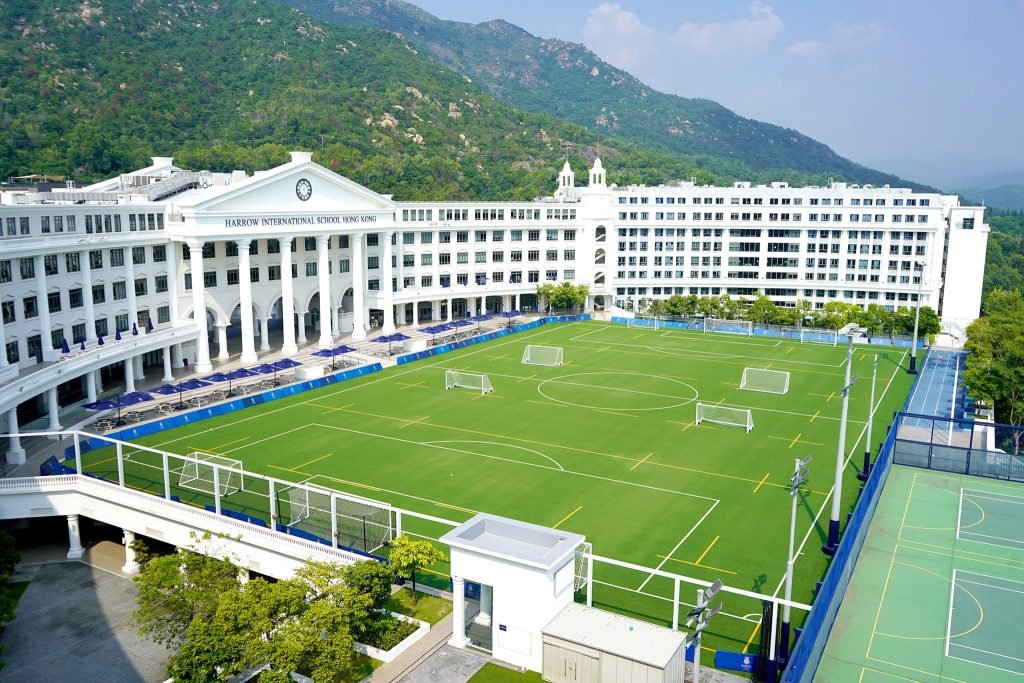
The school eventually established facilities serving different stages of education. Its campuses are located on the southern side of Hong Kong Island and provide specialized environments for different age groups.
The main school facilities are associated with the Repulse Bay and Rascal Bay areas, with the school community benefiting from Hong Kong’s distinctive geography.
The campus environment is very different from that of a traditional school in a flat suburban setting. Hong Kong’s mountains, coastline, dense urban development, and limited land availability have influenced the school’s physical design.
The campus environment provides students with access to modern educational facilities while also placing them within the distinctive natural and urban landscape of Hong Kong.
American Educational Philosophy
A major characteristic of Hong Kong International School is its American educational foundation.
The school does not simply provide an education in English. Its broader philosophy reflects many principles associated with American independent and international schools.
These include:
- Critical thinking
- Independent learning
- Creativity
- Collaboration
- Communication
- Leadership
- Community service
- Personal responsibility
- Academic exploration
- Character development
Students are encouraged to participate actively in their education.
Instead of viewing education as simply the transfer of information from teacher to student, HKIS places importance on developing students who can ask questions, investigate problems, express ideas, and work with others.
This approach has helped shape the school’s academic culture.
Elementary School
The elementary school years represent the foundation of a student’s educational experience at HKIS.
At this stage, the school focuses on developing fundamental academic skills while also encouraging curiosity and confidence.
Students learn subjects such as:
- English language arts
- Mathematics
- Science
- Social studies
- World languages
- Visual arts
- Music
- Physical education
- Technology
However, elementary education is not limited to traditional classroom subjects.
Students also participate in activities designed to encourage collaboration and problem-solving.
Teachers play an important role in helping young students develop positive attitudes toward learning.
The goal is to create an environment in which children feel comfortable asking questions, making mistakes, exploring ideas, and developing new skills.
Middle School Education
The middle school years bring new academic and social challenges.
Students become increasingly independent learners and are introduced to more specialized subjects.
The curriculum becomes broader and deeper, allowing students to explore different areas of knowledge.
Middle school education often focuses on helping students develop organizational skills, responsible decision-making, communication abilities, and stronger academic habits.
Students may participate in:
- Athletics
- Performing arts
- Visual arts
- Student organizations
- Community service
- Technology projects
- Leadership opportunities
- Academic competitions
These activities complement classroom education.
The middle school experience is designed to help students prepare for the more demanding academic environment of high school.
High School at HKIS
The high school program represents one of the most important stages of education at Hong Kong International School.
Students are expected to take greater responsibility for their academic progress and future goals.
The high school curriculum includes a wide range of subjects, allowing students to build programs that reflect their interests and aspirations.
Students can explore disciplines including:
- Mathematics
- Sciences
- Humanities
- English
- World languages
- Fine arts
- Performing arts
- Computer science
- Business
- Social sciences
- Physical education
Advanced academic opportunities are also available.
One of the distinctive features of the high school experience is preparation for university.
Because HKIS serves a highly international student population, graduates may apply to universities in the United States, Canada, the United Kingdom, Hong Kong, Asia, Europe, Australia, and other parts of the world.
The school therefore places substantial importance on university preparation and counseling.
Academic Excellence
Academic excellence is one of the central objectives of Hong Kong International School.
The school seeks to challenge students while recognizing that academic success involves more than examination results.
Students are encouraged to develop intellectual curiosity and the ability to think critically.
A strong academic program provides students with opportunities to investigate complex questions and understand different perspectives.
Teachers can serve not only as instructors but also as mentors who guide students through increasingly sophisticated academic work.
The academic environment encourages students to take responsibility for their learning.
Advanced and Specialized Learning
As students progress through high school, they can pursue more advanced academic subjects.
Advanced courses allow students to explore topics in greater depth and prepare for university-level study.
Depending on their interests, students can study advanced mathematics, laboratory sciences, literature, history, social sciences, languages, arts, technology, and other fields.
This breadth is important because international students have different goals.
Some may aspire to careers in medicine or engineering.
Others may be interested in business, law, technology, art, design, communications, social sciences, or the humanities.
A broad curriculum allows students to begin developing these interests before university.
International Perspective
Although HKIS has an American educational foundation, its location in Hong Kong gives the school a strongly international character.
Students come from a wide variety of cultural and national backgrounds.
This diversity provides an important educational advantage.
Students do not learn about global cultures only through textbooks. They encounter different perspectives in their classrooms, friendships, extracurricular activities, and community life.
The international environment can help students develop:
- Cultural awareness
- Empathy
- Communication skills
- Global understanding
- Respect for different perspectives
- Adaptability
These qualities are increasingly important in a global economy.
Life in Hong Kong and the HKIS Experience
Hong Kong itself is an important part of the educational experience.
Students live in one of Asia’s most dynamic cities.
Hong Kong combines modern skyscrapers and financial districts with mountains, beaches, traditional neighborhoods, markets, temples, parks, and historic communities.
This environment provides many opportunities for learning outside the classroom.
Students can explore questions related to:
- Urban development
- Economics
- Environmental sustainability
- Chinese history
- Asian culture
- International business
- Architecture
- Geography
- Public policy
The city can therefore function as an extension of the classroom.
Extracurricular Activities
Education at HKIS extends beyond academic subjects.
Extracurricular activities are an important part of student life.
Students can participate in numerous activities depending on their age and interests.
These may include:
- Sports
- Music
- Theater
- Debate
- Student government
- Community service
- Clubs
- Technology
- Art
- Academic competitions
Extracurricular programs allow students to discover talents that may not become visible through traditional academic subjects.
For example, a student who struggles to find confidence in a classroom may discover leadership abilities through athletics or theater.
Another student may develop teamwork skills through a sports team or service project.
Athletics at Hong Kong International School
Athletics has traditionally been an important part of international school culture.
Sports can teach students discipline, teamwork, communication, resilience, and leadership.
HKIS offers opportunities for students to participate in different sports.
Depending on age and season, students may participate in sports such as:
- Basketball
- Volleyball
- Soccer
- Swimming
- Track and field
- Cross-country
- Tennis
- Other competitive and recreational activities
School sports also create opportunities for students to represent HKIS in inter-school competitions.
These experiences contribute to school spirit and community identity.
Arts and Creative Education
The arts are another important component of the school’s educational philosophy.
Students have opportunities to study visual arts, music, theater, and other creative disciplines.
Arts education encourages imagination and self-expression.
It can also strengthen communication skills and confidence.
Performing arts programs can involve:
- Concerts
- Musical performances
- Theater productions
- Choir
- Instrumental music
- Dance
- Student performances
Visual arts programs similarly allow students to experiment with different media and develop their own creative approaches.
Technology and Innovation
Modern education requires students to understand technology.
HKIS has incorporated technology into teaching and learning as educational practices have evolved.
Technology can support research, communication, collaboration, creative production, and problem-solving.
Students may use digital tools to conduct research, create presentations, develop multimedia projects, analyze information, and communicate ideas.
However, technology is generally most valuable when it supports deeper learning rather than simply replacing traditional educational methods.
The school’s broader educational objective is to prepare students to use technology responsibly and effectively.
Community Service
Community service is an important part of developing socially responsible students.
Students are encouraged to understand that education also involves responsibility toward other people.
Service opportunities can allow students to work with organizations and communities in Hong Kong and beyond.
Through service learning, students may explore issues such as:
- Poverty
- Education
- Environmental protection
- Social inequality
- Community development
- Human welfare
These experiences can help students understand social issues through direct engagement rather than theoretical discussion alone.
Character Development
Academic achievement is only one aspect of education.
HKIS also places importance on developing students as responsible and thoughtful individuals.
Character education can involve values such as:
- Integrity
- Respect
- Responsibility
- Compassion
- Courage
- Honesty
- Leadership
- Service
The goal is to help students understand that success involves not only what they accomplish but also how they treat other people.
Student Leadership
Leadership opportunities are available throughout the school experience.
Students can take leadership roles in clubs, sports, student government, community service, arts programs, and other activities.
Leadership education teaches students to:
- Make decisions
- Communicate effectively
- Work with teams
- Solve conflicts
- Take responsibility
- Organize projects
- Support others
These skills can become valuable later in university, professional life, and the wider community.
Faculty and Teachers
Teachers are central to the success of any school.
At HKIS, educators work in an environment characterized by international diversity and academic expectations.
Teachers must understand not only their subjects but also the needs of students from different backgrounds.
A diverse student population can require flexible teaching strategies.
The teacher’s role may include instructor, advisor, mentor, coach, and community leader.
Strong teacher-student relationships can contribute significantly to student success.
The Role of Parents
Parents are also an important part of the HKIS community.
International schools often function as communities rather than simply educational institutions.
Parents participate in school activities, events, organizations, volunteering, and community programs.
Strong communication between families and the school can help students succeed academically and socially.
Parent involvement also contributes to the development of a strong school culture.
Diversity at HKIS
One of the most distinctive aspects of Hong Kong International School is its diversity.
Students may have connections to many different countries and cultural traditions.
This diversity creates an environment where students regularly encounter perspectives different from their own.
In a world where international cooperation is increasingly important, such experiences can be extremely valuable.
Students learn that there may be multiple ways to approach a problem or understand an event.
They can also develop friendships across cultural boundaries.
Alumni of Hong Kong International School
Over its long history, HKIS has produced graduates who have continued their education at universities around the world.
Alumni have entered fields including:
- Business
- Medicine
- Law
- Engineering
- Technology
- Arts
- Education
- Media
- Government
- Finance
- Entrepreneurship
- Science
The alumni community represents one of the school’s lasting contributions to international education.
Graduates carry the experiences of their school years into different countries and professions.
University Preparation
University preparation is a major component of high school education.
Students receive guidance as they consider potential universities and career paths.
University counseling can help students understand:
- Admission requirements
- Application deadlines
- Academic preparation
- Personal statements
- Standardized testing
- University selection
- Financial considerations
- Career interests
Because HKIS students apply internationally, university counseling must account for different higher-education systems.
A student applying to a U.S. university may follow a different process from a student applying to a university in the United Kingdom or Hong Kong.
This international orientation is an important feature of the school’s university preparation.
The Importance of Accreditation
Accreditation provides external recognition that a school meets established educational standards.
HKIS has maintained relationships with recognized educational organizations and accreditation bodies.
Accreditation can provide reassurance to families that the school operates according to defined standards involving curriculum, governance, facilities, student support, and educational quality.
For an international school, accreditation is particularly important because families may move between countries.
The School’s Relationship with Hong Kong
HKIS has always been influenced by its location.
Although its educational foundation is American, the school exists within Hong Kong society.
Students experience the unique cultural environment of the territory.
The school therefore occupies an interesting position between American educational traditions and Asian cultural surroundings.
This combination is one reason the institution has remained distinctive.
Students can receive an American-style education while living in one of Asia’s most important cities.
Challenges in the School’s History
Like any major institution, HKIS has faced challenges throughout its history.
International schools must respond to changing demographics, educational expectations, technology, economic conditions, and global events.
The school has also had to balance continuity with innovation.
Families expect a modern education, but schools must also protect the traditions and values that define their identity.
Maintaining this balance is one of the ongoing challenges of educational leadership.
Adaptation to a Changing World
Education has changed dramatically since the 1960s.
When HKIS was founded, classrooms relied heavily on textbooks, printed materials, and traditional teaching methods.
Today, students live in a world shaped by:
- Artificial intelligence
- Digital communication
- Globalization
- Social media
- Rapid technological change
- International business
- Climate challenges
- New forms of employment
Schools must therefore prepare students for jobs and challenges that may not yet exist.
This requires teaching students how to learn, adapt, evaluate information, and solve unfamiliar problems.
Environmental Awareness
Environmental issues have become increasingly important in modern education.
Hong Kong’s geography makes environmental education particularly relevant.
The city combines dense urban development with mountains, forests, coastlines, islands, and marine environments.
Students can therefore study environmental questions in a real-world context.
Topics may include:
- Climate change
- Conservation
- Sustainability
- Waste reduction
- Energy use
- Biodiversity
- Water resources
Environmental education encourages students to think about the long-term effects of human decisions.
Global Citizenship
One of the strongest themes associated with international education is global citizenship.
Global citizenship does not mean abandoning local identity.
Instead, it means understanding that people and societies are connected.
HKIS students live in a city that is deeply connected to the international economy.
They may interact with people from many countries and eventually study or work abroad.
This environment can encourage students to think beyond national boundaries.
Why Hong Kong International School Is Significant
HKIS is significant for several reasons.
First, it was among the institutions that helped establish international education as an important part of Hong Kong’s educational landscape.
Second, it has provided generations of students with an American-style education in Asia.
Third, it has developed a multicultural school community.
Fourth, it has helped graduates prepare for universities and careers across the world.
Finally, its history demonstrates how educational institutions can evolve alongside the societies they serve.
The Modern HKIS Experience
Modern Hong Kong International School combines established educational traditions with contemporary approaches.
Students benefit from academic programs, technology, extracurricular activities, athletics, arts, service learning, and university counseling.
The school community remains international, reflecting Hong Kong’s role as a global city.
Students are expected to develop academically while also becoming independent, responsible, and engaged members of society.
The modern school therefore represents the continuation of an educational project that began in the 1960s.
Admissions and Choosing HKIS
For families considering HKIS, admissions can be an important process.
International schools often receive applications from families with diverse backgrounds.
Families should carefully review the school’s current admissions requirements, grade-level availability, application procedures, tuition information, and enrollment policies before applying.
Because these details can change over time, prospective families should consult the school’s official admissions information for the latest requirements.
Parents should also consider whether the school’s educational philosophy matches their child’s learning style and long-term goals.
What Makes HKIS Different?
Several features contribute to HKIS’s distinctive identity.
1. American Educational Foundation
The school offers an educational approach influenced by American traditions.
2. International Community
Students and families represent a broad range of backgrounds.
3. Hong Kong Location
Students live and learn in one of Asia’s most dynamic cities.
4. Comprehensive Education
The school combines academics, athletics, arts, service, and leadership.
5. Global University Pathways
Graduates can pursue higher education in many countries.
6. Long History
The institution has decades of experience providing international education.
The Legacy of Hong Kong International School
The legacy of HKIS extends beyond buildings and classrooms.
Its most important contribution is the education of generations of students.
Every graduating class becomes part of a global alumni network.
Graduates carry with them academic knowledge, friendships, cultural experiences, and lessons learned through participation in school life.
The school’s influence can therefore be understood through the people who have passed through its classrooms.
Future of Hong Kong International School
The future of HKIS will likely be shaped by the changing needs of students and the world around them.
Education will continue to evolve as artificial intelligence, technology, globalization, and environmental challenges become increasingly important.
Schools will need to teach students not merely how to remember information but how to evaluate, question, create, collaborate, and adapt.
HKIS’s international character gives it a strong foundation for this future.
Its students are already growing up in a highly connected environment.
The challenge will be to ensure that education remains academically rigorous while also preparing students for an uncertain future.
Conclusion
Hong Kong International School has developed from a small educational institution established in 1966 into one of Hong Kong’s prominent international schools.
Its history reflects the growth of Hong Kong as an international center and the increasing importance of global education.
From its American educational foundation to its modern international community, HKIS has maintained a distinctive identity.
The school’s educational philosophy emphasizes academic achievement, creativity, critical thinking, leadership, service, athletics, arts, and personal development.
Its location in Hong Kong adds another important dimension to the student experience. Students are surrounded by a city where cultures, languages, economies, traditions, and technologies meet.
Over the decades, HKIS has adapted to changes in education and society while maintaining its central commitment to preparing students for a changing world.
Its legacy can be seen in its graduates, faculty, families, and broader community.
For students seeking an international education with an American foundation, a diverse community, broad extracurricular opportunities, and access to a globally connected city, Hong Kong International School represents an important chapter in the history of international education in Asia.
Ultimately, the story of Hong Kong International School is not simply the story of a school. It is the story of how education can connect cultures, prepare young people for international opportunities, and evolve alongside a changing society.