Introduction
Wellington College is one of the United Kingdom’s best-known historic independent schools. Located in Crowthorne, Berkshire, the school has developed from a Victorian institution established in memory of the Duke of Wellington into a modern educational community with an international reputation. Its history reflects many of the major changes that have taken place in British education, society, culture, sport and public life.
Founded during the nineteenth century, Wellington College was created with an ambitious purpose. It was not simply intended to be another traditional boarding school. Its founders wanted an institution that would honour the memory of Arthur Wellesley, the first Duke of Wellington, while providing an education appropriate for the changing needs of Britain.
Over more than a century and a half, Wellington College has experienced periods of expansion, social change, two World Wars, educational reform and the transformation of British independent schooling. Throughout these changes, the school has maintained a strong emphasis on academic achievement, character, leadership, community and participation beyond the classroom.
Today, Wellington College combines historic architecture and traditions with modern educational ideas. Its large campus, boarding houses, academic departments, sports facilities, performing arts programmes and extracurricular opportunities make it a distinctive institution within British education.
This article explores the complete history of Wellington College, from its origins and foundation to its development in the modern era.
The Origins of Wellington College
The story of Wellington College begins with the death of Arthur Wellesley, the first Duke of Wellington, in 1852.
The Duke of Wellington was one of the most influential military and political figures in nineteenth-century Britain. He is particularly remembered for his role in the Napoleonic Wars and for commanding the Allied forces at the Battle of Waterloo in 1815.
Following his death, there was widespread public discussion about how Britain should commemorate such an important national figure. A proposal emerged to establish an educational institution in his honour.
The idea was significant because education was already undergoing major changes during the Victorian period. Britain was becoming increasingly industrialised and socially complex, and there was growing recognition that education played an important role in national development.
The creation of Wellington College therefore served two purposes. It would commemorate the Duke of Wellington while also providing education for future generations.
The Foundation of Wellington College
Wellington College was founded through a combination of royal support, government involvement and public fundraising.
Queen Victoria and Prince Albert were closely associated with the establishment of the school. Their support reflected the importance attached to Wellington’s memory and to the educational ambitions of the project.
The institution was intended to educate sons of officers of the British Army, although its educational role eventually developed much more broadly.
The location selected for the school was near Crowthorne in Berkshire. The surrounding landscape provided the space required for a large boarding school campus.
The architecture of Wellington College was designed to create a monumental institution worthy of the Duke’s memory. The main buildings were constructed in a distinctive Victorian style, giving the school a strong architectural identity.
Opening of the School
Wellington College officially opened in the nineteenth century and soon became an important British boarding school.
The early years were focused on establishing the school’s educational structure, traditions and community. Like many Victorian public schools, Wellington placed considerable importance on discipline, personal responsibility, academic study and physical activity.
Boarding was central to school life. Students lived within the school community, participated in organised activities and developed relationships that often continued long after graduation.
The school gradually developed its own traditions, house system, sporting culture and academic identity.
Wellington College and the Victorian Era
The Victorian period was a time of enormous change in Britain. The country was expanding economically and technologically, while the British Empire was becoming increasingly influential around the world.
Schools were expected to prepare young people for leadership and public service.
Wellington College reflected many of these Victorian ideals. Education was not limited to classroom subjects. Students were encouraged to develop discipline, confidence, physical fitness and a sense of responsibility.
Classical subjects such as Latin and Greek were important parts of traditional British education, while mathematics, science and modern languages also became increasingly significant.
The school’s connection with military families remained important during its early history, but its educational mission continued to evolve.
The Duke of Wellington’s Legacy
The Duke of Wellington remains central to the identity of Wellington College.
His reputation was built primarily around military leadership, particularly his victory over Napoleon at Waterloo. However, he was also a political leader who served as Prime Minister of the United Kingdom.
The school was therefore founded not merely to celebrate military success but to commemorate a major figure in British national life.
His qualities of discipline, leadership and determination became associated with the institution.
Over time, Wellington College developed a broader understanding of leadership. Modern education at the school places emphasis not only on authority but also on cooperation, communication, creativity, resilience and service.
Campus and Architecture
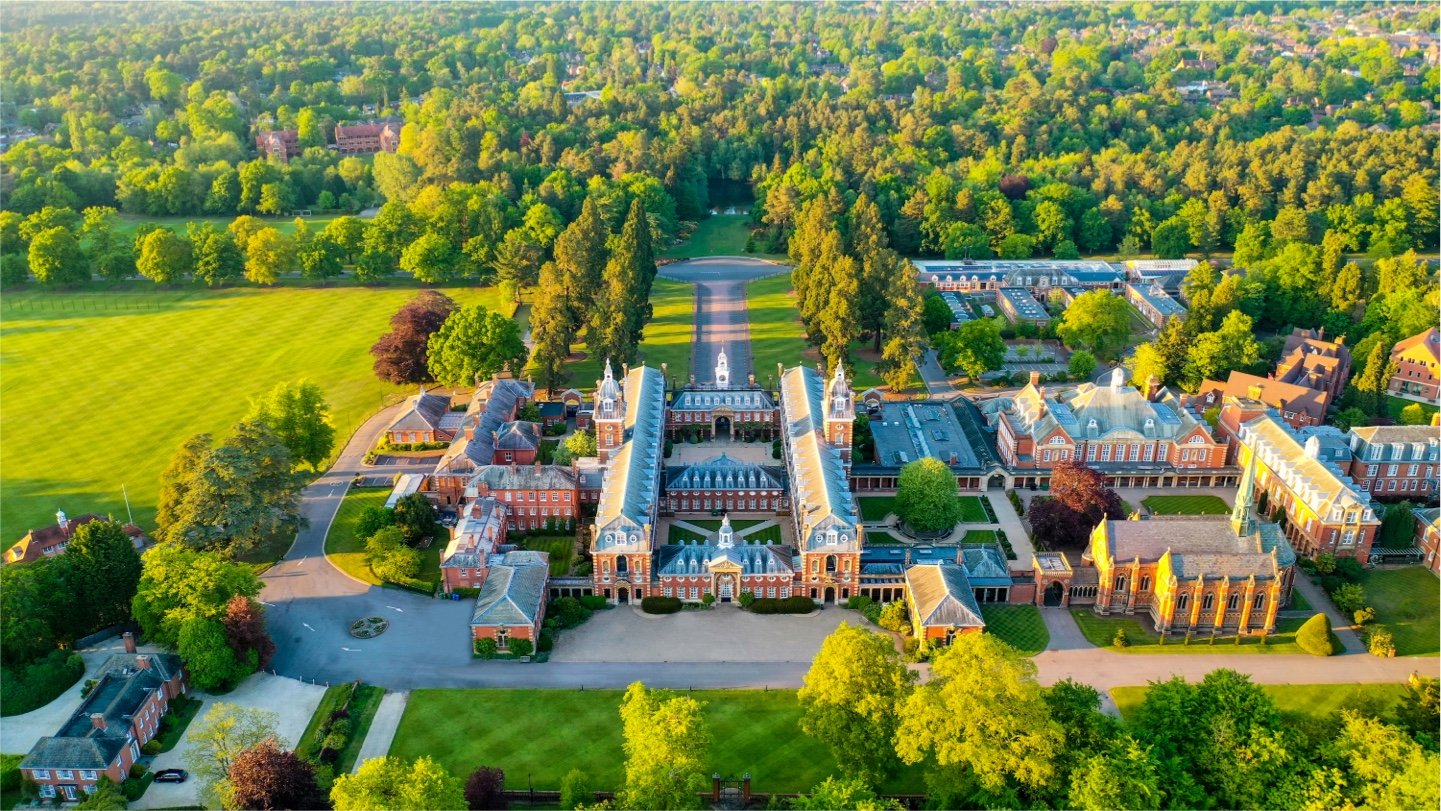
One of the most distinctive features of Wellington College is its historic campus.
The school occupies an extensive site surrounded by woodland and open landscapes. The architecture provides a visible connection between the institution’s Victorian origins and its modern educational purpose.
The main buildings were designed to create an impressive central focus for the school. Their scale and architectural style reflect the importance that Victorian society placed on national memorials and educational institutions.
Over the decades, additional buildings and facilities have been introduced.
Modern Wellington College includes academic buildings, boarding houses, sports facilities, arts spaces, libraries, dining areas and other specialist facilities.
This mixture of old and new is an important part of the school’s character.
Boarding School Tradition
Boarding has historically been one of the defining features of Wellington College.
Students live in houses where they develop a strong sense of community. House life provides opportunities for friendships, competition, leadership and participation in activities.
The house system also creates a structure through which students can take part in sporting competitions, cultural activities and other events.
For many pupils, boarding becomes one of the most memorable aspects of their school experience.
The boarding tradition also contributes to Wellington’s emphasis on independence. Students learn to organise their time, manage responsibilities and interact with people from different backgrounds.
Education at Wellington College
Education at Wellington College has changed significantly since the nineteenth century.
The traditional curriculum has expanded to include a wide range of modern academic disciplines.
Students may study subjects across the humanities, sciences, languages, mathematics, arts and social sciences.
The school also places importance on independent thinking.
Rather than simply memorising information, students are encouraged to ask questions, analyse evidence, debate ideas and develop their own perspectives.
This approach reflects broader changes in modern education.
Academic Excellence
Academic achievement remains an important part of Wellington College’s identity.
The school provides a challenging academic environment in which students are encouraged to reach their potential.
Teachers play an important role in supporting students academically while also encouraging intellectual curiosity.
The school’s educational philosophy recognises that students have different strengths.
Some may excel in mathematics and sciences, while others may demonstrate exceptional ability in literature, languages, music, drama, art or sport.
A broad educational environment allows students to develop multiple talents.
Science and Technology
Science education has become increasingly important at Wellington College.
Modern schools must prepare students for a world shaped by technology, scientific research and rapid innovation.
Subjects such as biology, chemistry and physics provide students with opportunities to understand the natural world and develop analytical skills.
Technology has also become part of modern learning.
Students increasingly use digital tools for research, communication, collaboration and creative work.
The integration of technology demonstrates how Wellington College has adapted to contemporary educational requirements while maintaining its historic identity.
Humanities and Social Sciences
The humanities continue to play an important role in education at Wellington.
History helps students understand political, social and cultural change.
Geography provides an understanding of environments, economies and global relationships.
Literature encourages students to explore language, ideas and human experience.
Modern education in these areas is increasingly international in perspective. Students are encouraged to understand different societies and cultures rather than viewing history solely through a British lens.
Languages
Language learning has traditionally been an important part of British independent education.
At Wellington College, modern language education provides students with opportunities to communicate across cultural boundaries.
Learning another language can improve communication skills while also helping students understand different ways of thinking.
In an increasingly interconnected world, language skills can be valuable for university study, international careers and global relationships.
Arts and Creativity
Education at Wellington College extends beyond traditional academic subjects.
Art, music, drama and other creative disciplines provide students with opportunities to develop imagination and confidence.
Creative activities can also teach valuable skills such as teamwork, presentation and persistence.
Drama, for example, requires students to collaborate closely while developing communication and performance skills.
Music provides opportunities for individual practice as well as ensemble performance.
The arts therefore form an important part of a balanced education.
Sport at Wellington College
Sport has always played an important role in British boarding-school culture.
At Wellington College, sporting activities provide opportunities for physical development, competition and teamwork.
Students can participate in a wide range of sports and physical activities.
Competitive sport teaches students how to deal with both success and disappointment.
It also encourages discipline and cooperation.
For many students, sport becomes an important part of their social experience at school.
Character Education
One of the most important developments in modern education is the growing emphasis on character.
Academic qualifications are valuable, but schools also have a responsibility to help students develop qualities that will serve them throughout life.
Wellington College has become particularly associated with the idea that education should address the whole person.
Students are encouraged to develop resilience, confidence, empathy, leadership and responsibility.
These qualities can be developed through academic study, sport, arts, community activities and everyday school life.
Leadership at Wellington College
Leadership is strongly connected with the historical identity of Wellington College.
The school was founded in memory of a famous military commander and political leader, making leadership a natural part of its heritage.
Modern leadership education, however, is broader than military command.
Students can develop leadership through school societies, sports teams, house responsibilities, community projects and student organisations.
Effective leadership requires listening as well as speaking.
It requires understanding other people, accepting responsibility and making thoughtful decisions.
Wellington College During the First World War
The First World War had a major impact on British schools.
Wellington College, like many institutions of the period, was affected by the conflict.
Former pupils and members of the school community served in the armed forces.
The war changed British society profoundly. Many young men who had been educated in the years before the conflict went directly from school into military service.
The human cost of the war was enormous.
Memorials and commemorations at schools across Britain helped preserve the memory of those who died.
At Wellington College, the legacy of the First World War became part of the institution’s historical memory.
The Interwar Period
The years between the First and Second World Wars brought significant changes.
British society became more democratic and socially diverse.
Education also evolved.
Traditional ideas about class, authority and discipline began to change, although many boarding-school traditions remained strong.
Wellington College continued to develop academically and institutionally during this period.
Students were educated in an environment that combined traditional values with a gradually changing society.
Wellington College During the Second World War
The Second World War once again affected Wellington College and its community.
The school had to operate during a period of national crisis.
Former students and members of the wider school community served in military and other wartime roles.
The war also influenced education itself.
Schools had to consider issues of safety, national service and the changing needs of young people.
After 1945, Britain entered a new era.
The country was rebuilding economically and socially, and the role of education was changing rapidly.
Post-War Britain and Educational Change
The decades following the Second World War were among the most transformative in British education.
The expansion of secondary education, changes in university access and developments in teaching methods affected independent schools as well as state schools.
Wellington College adapted to these developments.
Academic programmes expanded, facilities improved and the school’s educational philosophy continued to evolve.
The traditional boarding-school model remained important, but students increasingly prepared for a world very different from that of the Victorian founders.
Modernisation of Wellington College
During the late twentieth and early twenty-first centuries, Wellington College increasingly became associated with educational innovation.
The school continued to value academic achievement while paying greater attention to personal development, wellbeing, creativity and global awareness.
Modern facilities were introduced alongside the preservation of historic buildings.
This balance between heritage and innovation is one of the school’s defining characteristics.
Wellington College in the Twenty-First Century
The twenty-first century has brought new challenges to education.
Students now grow up in a world shaped by the internet, artificial intelligence, global communication, social media and rapid technological change.
Schools must prepare students not only for existing careers but also for professions that may change dramatically in the future.
Wellington College has continued to adapt its educational approach to these realities.
Critical thinking, creativity, collaboration and adaptability have become increasingly important.
Global Outlook
Modern Wellington College has a strong international outlook.
Although the school is deeply connected to British educational traditions, its students and community are part of an increasingly global society.
International awareness can be developed through language learning, cultural activities, global issues and interactions between students from different backgrounds.
This international perspective reflects the changing nature of higher education and employment.
Universities and employers increasingly value students who can communicate and collaborate across cultures.
Extracurricular Activities
A major feature of Wellington College life is the wide range of activities available outside formal lessons.
Students can become involved in sports, music, drama, debating, societies, clubs and community activities.
Extracurricular participation helps students discover interests that may not emerge through academic study alone.
A student who struggles to find a passion in the classroom may discover a talent for theatre, music, sport, public speaking or another activity.
This is why extracurricular education is important.
Community and Service
Community service is another important element of a broad education.
Schools have the opportunity to encourage students to understand their responsibilities to other people.
Service projects can help students develop empathy and practical skills.
They can also demonstrate that leadership is not simply about personal achievement.
A successful leader should understand the needs of others and contribute positively to society.
The Importance of Resilience
Resilience has become an increasingly important concept in education.
Young people face academic pressure, social challenges and uncertainty about the future.
A strong educational environment can help students learn how to respond to setbacks.
At Wellington College, resilience can be developed through challenging academic work, competitive sport, performances, leadership responsibilities and everyday experiences of boarding-school life.
The goal is not to eliminate failure but to teach students how to learn from it.
Wellington College and Personal Development
Personal development is closely connected to the school’s wider educational philosophy.
Students are encouraged to understand their own strengths and weaknesses.
They learn to set goals, manage responsibilities and develop relationships with others.
This approach recognises that education is more than examination results.
A successful education should prepare students for university, employment and adult life.
Notable Former Pupils
Over its long history, Wellington College has educated many individuals who have gone on to make contributions in different fields.
Former pupils have entered public service, the military, politics, business, science, literature, journalism, sport and the arts.
The achievements of alumni are an important part of the school’s history.
However, the significance of a school cannot be measured only by the fame of its former students.
Every generation contributes to the continuing story of the institution.
The Importance of Tradition
Traditions are an important part of Wellington College.
School traditions create continuity between generations.
A student entering the school today becomes part of a community that existed long before they arrived and will continue after they leave.
Traditions can include ceremonies, sporting events, house competitions, uniforms, school songs and commemorative activities.
At the same time, traditions must evolve.
A modern school needs to ensure that its customs remain meaningful and relevant.
The House System
The house system provides an important social structure.
Students belong to houses where they develop friendships and participate in competitions.
House activities may include sport, music, drama, debating and other events.
The system encourages students to work together.
It also provides opportunities for older students to take responsibility and support younger pupils.
Boarding and Independence
Boarding can be a major educational experience.
Living away from home encourages students to become more independent.
They learn practical skills such as organising their time, managing personal responsibilities and working with people from different backgrounds.
Boarding also creates a strong community.
Students spend a significant amount of time together, creating friendships that can last for many years.
Teachers and Mentors
Teachers are central to the Wellington College experience.
A teacher’s role extends beyond delivering lessons.
Teachers can act as mentors, advisers and role models.
Students benefit from relationships with adults who understand their interests and help them navigate challenges.
Good teaching encourages curiosity rather than simply providing answers.
University Preparation
For many students, Wellington College provides preparation for university.
Academic programmes are designed to develop the knowledge and skills required for higher education.
Students may receive guidance on choosing subjects, applying to universities and preparing for future careers.
However, university preparation is only one part of the educational experience.
The broader goal is to produce confident and capable young adults.
Wellington College and British Education
Wellington College occupies an interesting position within British education.
It represents many features traditionally associated with independent boarding schools, including historic buildings, house systems, boarding and extensive extracurricular programmes.
At the same time, the school has increasingly embraced modern approaches to education.
This combination makes Wellington an example of how historic institutions can adapt.
Heritage and Innovation
Perhaps one of the most interesting aspects of Wellington College is the relationship between heritage and innovation.
The school has a long history, but it does not exist only as a museum of Victorian education.
Instead, its historic identity provides a foundation from which new educational approaches can develop.
Modern students may use technologies and study subjects that would have been unimaginable to the school’s founders.
Yet they still walk through historic spaces and participate in traditions that connect them with previous generations.
Why Wellington College Remains Important
Wellington College remains important because of its ability to combine several aspects of education.
It offers academic opportunities, extracurricular activities, sport, arts, leadership and community life.
Its historic identity gives students a strong sense of belonging.
Its modern educational philosophy prepares them for a changing world.
This balance helps explain the school’s continuing reputation.
Challenges Facing Modern Independent Schools
Like other independent schools, Wellington College operates in a changing educational environment.
Independent schools face questions about affordability, accessibility, educational technology, student wellbeing and their role within wider society.
Modern schools must demonstrate that their educational model provides meaningful value.
They must also ensure that students are prepared for a world where traditional career paths are changing.
Wellington College’s continued development reflects these wider challenges.
The Future of Wellington College
The future of Wellington College will depend on its ability to preserve its strengths while continuing to evolve.
Technology will undoubtedly play an increasing role in education.
Artificial intelligence, digital learning and new forms of communication are already changing how students learn.
At the same time, human skills will remain essential.
Communication, empathy, creativity, teamwork and judgement cannot simply be replaced by technology.
A school with a long history therefore has an interesting challenge: it must prepare students for the future without losing the values that give the institution its identity.
Wellington College as a Historic Institution
Looking back across its history, Wellington College represents several important themes in British education.
Its foundation reflected Victorian ideas about national memory and education.
Its early development reflected the importance of discipline and leadership.
Its twentieth-century history demonstrates how schools were affected by war and social change.
Its modern development demonstrates the increasing importance of wellbeing, creativity, global awareness and personal development.
The institution has therefore changed considerably while maintaining continuity.
Conclusion
Wellington College has developed from a nineteenth-century memorial institution into a modern educational community with a distinctive international reputation.
Its foundation was closely connected to the memory of the Duke of Wellington, one of Britain’s most famous military and political figures. From its earliest days, the school was designed to combine education with values such as discipline, leadership and service.
Over the decades, Wellington College experienced the enormous changes of the Victorian period, the First World War, the interwar years, the Second World War and the social transformation of post-war Britain.
Its educational philosophy has continued to develop.
Today, Wellington College combines historic traditions with modern education. Academic study remains important, but students also have opportunities in sport, music, drama, art, leadership, community service and many other areas.
The school’s large campus and historic architecture provide a visible connection with its past, while its modern educational approach looks toward the future.
Ultimately, the history of Wellington College is not simply a story about buildings, famous people or institutional traditions. It is a story about generations of students and teachers and the changing meaning of education.
The school’s continuing challenge is to preserve what is valuable in its heritage while preparing young people for a world that is very different from the one in which the institution was founded.
That combination of history, tradition, innovation and ambition is what makes Wellington College an important subject for anyone interested in the history of British independent education.
Frequently Asked Questions About Wellington College
1. What is Wellington College?
Wellington College is a historic independent co-educational school in Crowthorne, Berkshire, England. It is known for its long history, boarding tradition, academic education, sports and extensive extracurricular programmes.
2. When was Wellington College founded?
Wellington College was founded in the nineteenth century as a memorial to Arthur Wellesley, the first Duke of Wellington.
3. Where is Wellington College located?
Wellington College is located near Crowthorne in Berkshire, England.
4. Why was Wellington College established?
The school was established to commemorate the Duke of Wellington and to provide an educational institution connected with his legacy.
5. Who was the Duke of Wellington?
Arthur Wellesley, the first Duke of Wellington, was a British military commander and statesman. He is particularly famous for defeating Napoleon at the Battle of Waterloo in 1815.
6. Is Wellington College a boarding school?
Yes. Boarding has historically been an important part of life at Wellington College, although the school also has day pupils.
7. Is Wellington College co-educational?
Yes. Wellington College is a co-educational independent school.
8. What subjects are taught at Wellington College?
The school offers a broad curriculum covering sciences, mathematics, humanities, languages, arts and other academic disciplines.
9. Does Wellington College offer sports?
Yes. Sport is an important part of school life, with students able to participate in a variety of sporting activities and competitions.
10. Why is Wellington College historically significant?
Wellington College is historically significant because of its Victorian foundation, connection with the Duke of Wellington, distinctive architecture and long contribution to British independent education.
11. Does Wellington College focus only on academics?
No. The educational experience includes academics as well as sport, arts, leadership, extracurricular activities, community involvement and personal development.
12. What makes Wellington College distinctive?
Its combination of historic heritage, boarding-school traditions, modern educational approaches, extensive campus and broad extracurricular opportunities makes Wellington College distinctive.
Final Thoughts
The story of Wellington College demonstrates how an educational institution can preserve its historical identity while responding to a changing world. From its Victorian origins to its modern educational environment, the school has continued to evolve.
For students interested in academic achievement, personal development, leadership, sport, creativity and community, Wellington College represents a distinctive example of British independent education.
Its history is therefore not simply a record of the past. It is an ongoing story in which each generation adds something new while remaining connected to the institution’s long and remarkable heritage.